Your kid just asked, "What's the difference between a solid and a liquid?" and you froze. Not because you don't know — but because explaining it without a textbook feels impossible. That's where science worksheets matter more than most parents realize. They turn abstract concepts into something a kid can actually touch, draw, and argue about.
Here's the thing: most science homework is a snooze. It's definitions and diagrams that feel like chores. But right now, when kids are drowning in screens and short attention spans, worksheets that make them stop and think — really think — are rare. I've seen a single good worksheet spark a 20-minute debate about whether steam "exists" or just disappears. Honestly, that's better than any video.
So what if you could find worksheets that don't just fill time but actually build that weird, wonderful curiosity? Ones that sneak in the hard stuff — like states of matter, chemical reactions, density — without your kid ever realizing they're learning. That's what we're digging into. Stick around and you'll know exactly which worksheets work, which ones are a waste of printer ink, and why "just coloring" can actually be science. Look — I've got opinions on this, and they might surprise you.
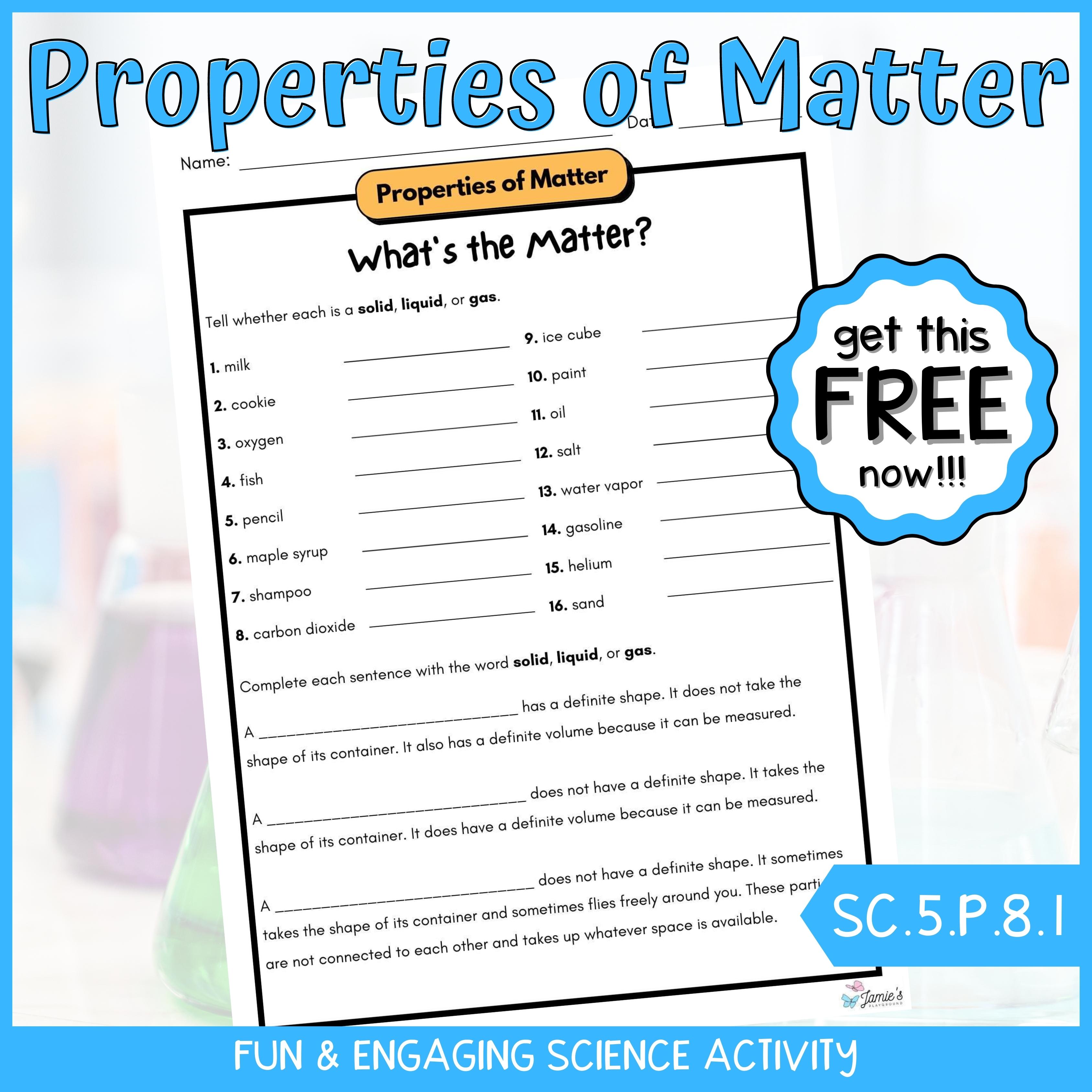
Most teachers and parents treat science worksheets like a checklist item. Hand them out, collect them, grade them, move on. That approach misses the entire point. When you use a worksheet on states of matter, you're not just testing if a kid can circle "gas" instead of "liquid." You're building a framework for how they observe and categorize the physical world. That distinction matters more than most people realize.
Why Most Science Worksheets Fail (And How to Fix It)
The biggest mistake I see in classrooms is using worksheets as busywork. A child fills in blanks without understanding why water vapor behaves differently than ice. That's not learning; it's transcription. The real value of a solid science worksheet lies in its ability to force a student to stop and think. A good sheet on properties of matter asks a kid to touch, observe, or recall a specific experience. Does it sink? Does it bend? Can you pour it? These questions train the brain to look for evidence, not just memorize definitions.
Here's what nobody tells you: the format of the worksheet matters as much as the content. If the font is cramped or the diagrams are unclear, you've lost half your audience before they start. I've watched fourth graders shut down because a worksheet on solids, liquids, and gases had a blurry image of a melting ice cube. That's a preventable disaster. Keep visuals clean. Leave white space. And for the love of all that is scientific, never put more than one concept on a single page. One sheet, one idea. That's the rule.
What a Strong "States of Matter" Worksheet Actually Includes
A useful worksheet on physical properties doesn't just ask for definitions. It asks for predictions. "What happens to the particles in a solid when you heat it?" is a better question than "Name three states of matter." The first forces reasoning. The second rewards memorization. You want the first. Worksheets that include a short experiment or observation log — even something as simple as recording what happens when you leave an ice cube on the counter — create lasting neural connections. That's the difference between a worksheet that gets filed in the trash and one that gets referenced weeks later during a lesson on evaporation.
Choosing Between Worksheet Types Without Overthinking It
Not all worksheets serve the same purpose. Some are diagnostic — they reveal what a student already knows. Others are instructional — they teach a new concept step by step. And some are purely for practice. You need to know which one you're using before you hand it out. Here's a quick breakdown based on what I've seen work in actual classrooms:
| Worksheet Type | Best Used For | Example Question |
|---|---|---|
| Diagnostic | Pre-assessment before a unit | "Draw what you think happens to the particles in a gas when it gets cold." |
| Instructional | Introducing a new concept | "Label the diagram showing particle arrangement in a solid, liquid, and gas." |
| Practice | Reinforcing learned ideas | "Circle all the examples of a liquid in this list." |
Notice that the diagnostic sheet asks for a drawing, not a multiple-choice answer. That's intentional. Open-ended formats reveal misconceptions better than any bubble sheet can. If a student draws particles floating away from a cold gas, you know exactly where to start your lesson.
The Part About Matter That Worksheets Almost Never Address
Here's the uncomfortable truth: most science worksheets about matter completely ignore the transition between states. They treat solid, liquid, and gas as three separate boxes. But the real magic — and the real confusion for kids — happens at the boundaries. When does a thick liquid become a solid? Is glass a solid or a very slow-moving liquid? These edge cases are where genuine scientific thinking lives. A worksheet that includes a question about non-Newtonian fluids or the behavior of melting butter will spark more curiosity than ten pages of fill-in-the-blank definitions.
How to Use One Worksheet Across Multiple Learning Styles
I've seen teachers take a single page on the properties of matter and turn it into a three-day lesson. Day one: read and discuss. Day two: do the hands-on component suggested in the margin. Day three: use the completed worksheet as the basis for a group discussion. That's resourcefulness. If you only have one solid worksheet, don't rush through it. Stretch it. Pair it with a simple demonstration — drop a marble in water, freeze a juice box, boil a kettle. The worksheet becomes the anchor, not the whole lesson. That's how you get mileage out of a single piece of paper.
One Specific Tip That Changed My Classroom
Stop grading every worksheet. I know that sounds radical, but hear me out. When students know every sheet gets a score, they play it safe. They guess less. They avoid taking intellectual risks. Instead, use a few science worksheets matter sheets per unit as ungraded "thinking pages." Tell the kids: "This one is for your brain, not for my gradebook." The quality of their answers will surprise you. They'll write weird hypotheses. They'll draw wrong diagrams. And then they'll correct themselves when you discuss it as a class. That self-correction is worth more than any circled letter grade. Trust me on this one.
What You Actually Do With This Tomorrow
Knowing the science behind science worksheets matter is one thing—but the real shift happens when you stop treating it as a lesson plan checkbox and start seeing it as a bridge. Every worksheet you hand a student is a quiet invitation: come closer, ask why, get your hands dirty with curiosity. In a world that rewards quick answers and scrolling, you are giving someone the gift of slow, deliberate discovery. That matters long after the bell rings.
Maybe you are thinking, But what if they still zone out? What if the worksheet feels flat? That is exactly the doubt that separates a good resource from a transformative one. You already have the instinct to make it better—you read this far. Trust that instinct. Pair your chosen science worksheets matter with a single question that starts with what if or why does. One question changes everything. You do not need a perfect lesson; you just need to start.
So here is the only push you need: bookmark this page right now. Pull it up the night before you teach a unit on states of matter or chemical reactions. Or better yet, send it to a colleague who has been struggling to get her students engaged. That small act of sharing is how real teaching happens—not in isolation, but in passing along a tool that works. Your next great science lesson is already waiting in the gallery above. Go grab it.